Induction Cooktops for Australian Kitchens
Induction cooktops are the fastest-growing cooktop choice in Australian homes, and for good reason. They heat faster than gas or electric, are safer around children, easier to clean, and more energy-efficient than any other cooktop type. At Everyday Home Living, we stock a wide range of induction cooktops in 60cm and 90cm widths from trusted brands, with fast delivery across Australia.
How Induction Cooking Works
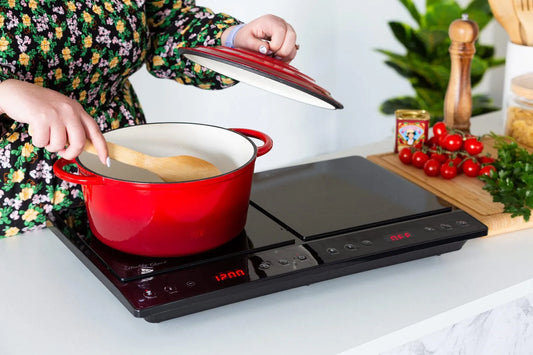
Induction cooktops use electromagnetic energy to heat the pan directly rather than the cooking surface. When a compatible pan is placed on a zone, a magnetic field induces an electrical current in the base of the pan, which generates heat within the pan itself. The cooktop surface around the pan remains cool to the touch, which makes induction significantly safer than gas or ceramic cooktops, particularly in households with children. Because the heat is generated in the pan rather than transferred from a surface, induction responds to power changes almost instantaneously, giving you precise temperature control that rivals gas.
Cookware Compatibility
Induction cooktops require cookware with a magnetic base. Compatible materials include stainless steel (most grades), cast iron, and enamelled iron. Copper, aluminium, and ceramic cookware will not work unless they have a magnetic disc bonded to the base. The simplest test is to hold a fridge magnet to the bottom of your pot. If it sticks firmly, the cookware will work on induction. Most modern cookware sold in Australia is induction-compatible and is clearly labelled on the packaging.
Key Features to Look For
Number of Zones and Layout
Standard 60cm induction cooktops have four cooking zones. 90cm models typically offer five zones and a larger total cooking area that suits households that regularly cook on multiple burners simultaneously. Some models include a flexible zone or bridge zone that combines two elements into one large cooking area for griddles, fish kettles, and oversized cookware.
Power Levels and Boost Function
Induction zones are rated in watts, typically 1,400W to 3,700W per zone. A boost or power function briefly draws extra power to bring large volumes of water to the boil significantly faster than the standard setting. This is a practical feature for everyday cooking where time matters.
Touch Controls and Timer
Most induction cooktops use touch-sensitive controls rather than knobs. Look for models with clear, easy-to-read displays and a child lock function. An integrated timer that automatically reduces or cuts power after a set time is useful for precise cooking and adds a safety layer.
Safety Features
Induction cooktops include an automatic pan detection function that activates the zone only when a compatible pan is present, and deactivates it when the pan is removed. Residual heat indicators warn you when a zone is still warm after use. These features make induction the safest cooktop type for family households.
Induction and Solar Power in Australia
For Australian households with rooftop solar, an induction cooktop is an excellent pairing. Cooking during daylight hours on solar-generated electricity effectively makes meal preparation free or very low cost. Induction's efficiency means it draws less from the grid or battery system than a conventional electric cooktop for the same cooking task.
Related Collections
Browse our full cooktops range to compare induction with gas, ceramic, and electric options. For a complete kitchen setup, explore our rangehoods and built-in ovens.
Frequently Asked Questions
Do I need to replace my cookware for an induction cooktop?
Only if your existing cookware is not induction-compatible. Test each pot and pan with a fridge magnet on the base. If the magnet sticks firmly, it will work. Most stainless steel and cast iron cookware is compatible. Copper, pure aluminium, and ceramic cookware without a magnetic base will not work. If you do need to replace some pieces, induction-compatible cookware is widely available in Australia at all price points.
Is induction cheaper to run than gas in Australia?
Induction cooktops convert approximately 85 to 90 percent of their energy input into heat in the pan, compared to around 40 to 55 percent for gas. However, the relative running cost depends on your electricity and gas tariffs. For households with rooftop solar, induction cooking during the day can be effectively free. For households on a standard electricity tariff without solar, gas may still be comparable in cost per cook depending on local gas and electricity prices. As gas network charges increase across Australian states, induction is becoming increasingly cost-competitive.
Can induction cooktops be installed in any kitchen?
Yes, provided a suitable electrical supply is available. Induction cooktops require a dedicated 240V circuit, and larger 90cm models with high total wattage may require a 20 amp or 32 amp circuit. Installation must be done by a licensed electrician. Unlike gas cooktops, induction does not require a gas connection or gas compliance certification, which simplifies installation in kitchens without an existing gas supply.